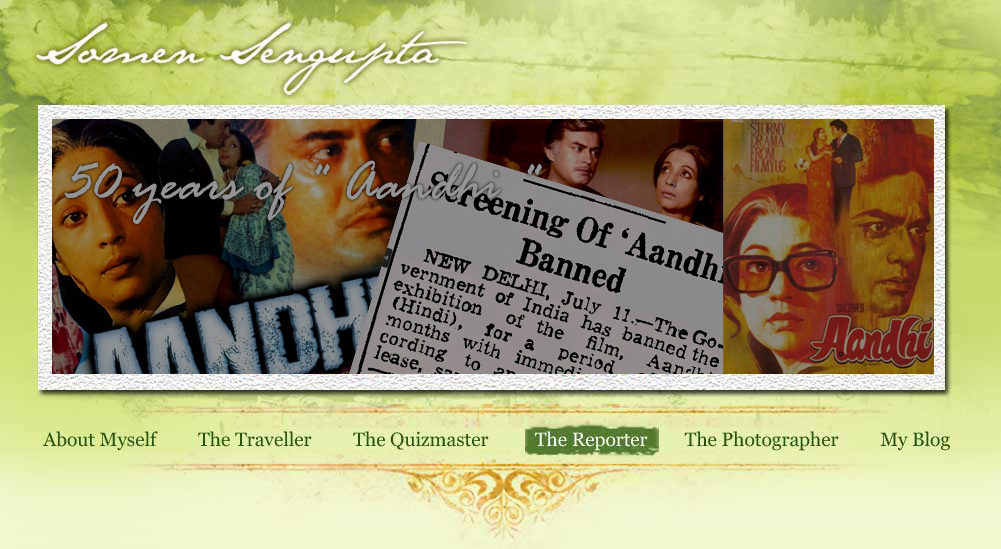
Gulzar’s Aandhi : Film that rocked Power Corridor 50 years ago
The Pioneer dated 31st August 2025
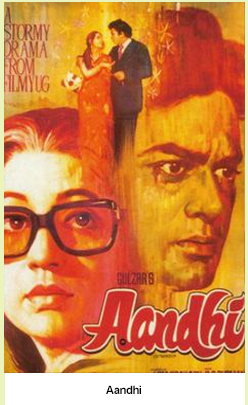 A film with strong political message often earns ruler’s wrath but 50 years ago the film Aandhi directed by Gulzar released on 14th February 1975 with a storyline of an emotionally devastated female politician was banned after 22 weeks of it’s successful running by a Government only on the basis of a baseless surmise that it has directly portrayed the Prime Minister of the country.
Gulzar the exceptional poet, lyricist and film maker had his cultural orientation in a school of cinema and literature which was dominated by Bengal and Bengalis. He had his initial grown up days in Bombay under the shadow of Bimal Roy, Rishikesh Mukherjee, SD Burman , Hemant Kumar, Asit Sen, Kishore Kumar and Sachin Bhowmik . He befriended with RD Burman and Rakhi Biswas who later became part of his life. All these Bengal connections dragged him closer to Bengali cinema and he from early 1950s he was engrossed with the magic spell of Suchitra Sen the prima donna of Bengal’s silver screen. Gulzar always nursed a dream in his heart to work with Sen and once he rushed to her Calcutta home to read a script . Sadly Gulzar did not like Suchitra’s dominating attitude in script reading session and left Calcutta by aborting the project.
Years later Gulzar again approached Suchitra and this time with an exceptional story never seen before on Indian silver screen. Gulzar wrote the story line and famous Hindi author Kamaleshwar developed the same into a script with additional dialogues added by Gulzar himself. This time Suchitra was excited to work with Gulzar and Sanjiv Kumar was eying to work with Suchitra Sen.
The story of Aandhi was exceptional.
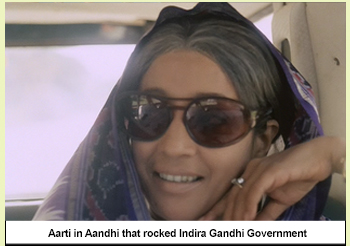 It talks about the pain and internal conflict of a lady politician whose life is challenged between domestic course and political career. It talks about the pain and internal conflict of a lady politician whose life is challenged between domestic course and political career.
This is surprising that by early 1970s India had a lady Prime Minister ruling the country with extra ordinary dominance and iron grip since 1966. Even before states like UP and Orissa had lady chief ministers viz Sucheta Kripalini and Nandini Sathpathy respectively. India had Vijay Laxmi Pandit as one of her top diplomat serving in US and Russia. It had Padmaja Naidu as Governor of Bengal. Still no one ever thought to capture the emotional tumult of a lady politician in public life.
Story of the film shown how a daughter of an ambitious politician indulged herself in the game of power by sacrificing her happy family leaving behind his ordinary husband whom she married against the wish of her powerful politician father. The film shown her in an unusual act of smoking and boozing in private something unthinkable for a lady politician in the decade of 1970’s India. In film she accidentally met her husband and broken emotionally. She repents of loosing a normal life of housewife but regains enough strength to go back to the corridor of power. Needless to say that one who knows the personal and political life of Indira will find enough reasons to watch the movie vividly for so much of similarities with screen and real life.
Plus in the film the character played by Suchitra was shaped up almost near resemblance of Indira of that time. Her partial white hairlines, big dark glasses, full sleeves blouse and few more physical signatures were injected in Suchitra’s screen appearance.
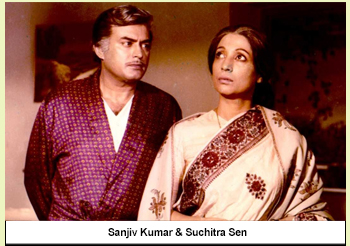 Above all the movie hit the theatre in such a time when India was slowly coming out of Indira Gandhi’s over rated larger than life image and many conducts of her son and herself were slowly ensuring her impending decline. Above all the movie hit the theatre in such a time when India was slowly coming out of Indira Gandhi’s over rated larger than life image and many conducts of her son and herself were slowly ensuring her impending decline.
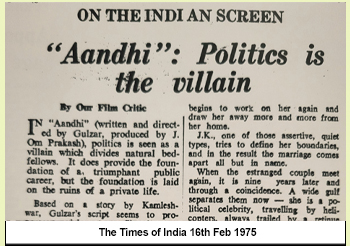
Aandhi won a rave reviews in most of the film journals and newspapers. The Times of India on 16th February 1975 wrote :
“ In many respects it is a pleasently different film….Suchitra Sen’s Arti is a superior feat.The faint smile, fthe quizzical look ,the confident air, the high pressure reticence, the tightly veiled sadness – she handles everything with fine ese….And there are moments when the script appears to lag behind here”.
Having said so TOI added “…..the woman politician with her tinted glasses, her solemn, proud, graceful manner and that elegant streak of white in her hair, tends to evoke at certain moment the well-known image of one of the contemporary world’s most renowned political figures.”
 Needless to say people started finding Indira in Aarti . In south India the film was campaigned with a punch line that reads “ Watch your Prime Minister on Screen”. Needless to say people started finding Indira in Aarti . In south India the film was campaigned with a punch line that reads “ Watch your Prime Minister on Screen”.
The film rocked both the box office and political circuit of that time.
It was return of Suchitra Sen to Hindi cinema after Mamta a big hit she delivered in 1966. This was enough to create a buzz in Bombay.
Secondly Gulzar exploited best outdoor locations of Kashmir in this film. He shot a songs in the archaeological ruins of Martand Sun temple of Anantanag a location largely unseen and unexplored in Hindi cinema.
The film has only one female character and that was the central one.
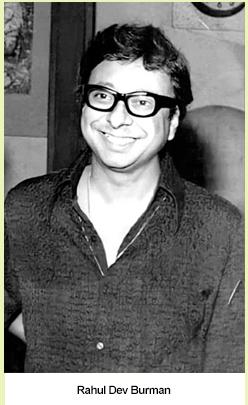 Rahul Dev Burman scored one of his career best tune for the film and recorded three immortal duet songs of Kishore Kumar and Lata Mangeshkar all picturized in breath taking panoramic valley and Mughal gardens of Kashmir with the background of snow-capped mountains. The songs of “ Aandhi “ are still one of the top downloaded songs in internet. Rahul Dev Burman scored one of his career best tune for the film and recorded three immortal duet songs of Kishore Kumar and Lata Mangeshkar all picturized in breath taking panoramic valley and Mughal gardens of Kashmir with the background of snow-capped mountains. The songs of “ Aandhi “ are still one of the top downloaded songs in internet.
From 1974 onwards the law of India was slowly becoming law of Sanjay Gandhi the unofficial powerhouse of India Gandhi’s eco system. With the imposition of emergency in June 1975 Sanjay’s extra constitutional conducts started crossing all democratic decorum and he simply over grown beyond the control of his mother who as her biographer Kathrine Frank started fearing him for all kind of abuses.
Hindi cinema became a soft target of Sanjay’s brutal aggression of running a system. Anyone or anything that fails to satisfy his ego was subject to his revenge . From banning Kishore Kumar from All India Radio to burning the reels of the movie “ Kissa Kursi Ka “ directed by Amrit Nahata and enacted Shabana Azmi inside of the Maruti factory of Gurgaon Sanjay Gandhi without holding any office of Government became a terror to any civilised society.
Indira too was not known for her kindness towards anyone who does anything ironical to indicative to her in any artistic form. Many cartoonists and newspaper editors often used to get cold threat from her office if she is ridiculed in any political cartoons. Her nature in this was just opposite of her father Nehru who used to appreciate political cartoons drawn on him.
Indira herself did not watch the movie but knowing the character Arti donning her shadow on screen she instructed IK Gujral former I& B minister ( and future Prime Minister of India ) under whom the movie passed the censor . Gujral watched the movie and assured Indira that there was nothing objectionable in it. By the time emergency was declared Gujral was replaced by Vidya Charan Shukla the very “ yes man “ of Sanjay as I & B minister.
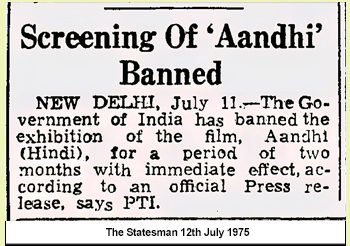
Sanjay was hell bent to crash the movie and by that time Indira had very little control over him. Thanks to his near equal power to mobilise decision Sanjay influenced Indira and the movie was banned on 11th July 1975 just within 16 days of emergency was announced.
 The Statesman on 12th July headlined “ Screening of “Aandhi “Banned “. The Statesman on 12th July headlined “ Screening of “Aandhi “Banned “.
The report said that the movie is banned for two months with immediate effect. Gulzar was in Moscow where he got the news. Suchitra was also very upset . By that time the film was doing fair to moderate business across India. It’s songs in disc was selling like hot cakes.
Till date it is not clear why Government banned the film but there is no doubt that the ban was a culmination of Sanjay’s personal wrath and anger on the presentation of the central character and the story. .
Gulzar never said that his film is based on Indira Gandhi. He always maintained that he wanted to show the hardship of a lady politician in Indian political arena. He in his memoir has written that he developed the story and script in a room of Delhi’s Akbar hotel and picked the name JK the character played by Sanjeev Kumar from there only. Even Kamaleshwar also said that the film is not a shadow biography of Indira but the character Aarti has little resemblance of Gayatri Devi of Jaipur.
In 1976 it got seven nominations in 23rd Film Fare award and won two out of that. Though it was nominated in almost all categories RD Burman was not nominated for best music director. Both Sanjeev Kumar and Suchitra Sen were nominated for best actor and actress but only Sanjeev Kumar was given award. Suchitra who played Arti was left out.
The ban on Aandhi was finally withdrawn in 1977 when Indira was thrown out of power and Janata Party formed first ever non-Congress Government of India. The ban was lifted with a special premier in television ensuring to make the film reach as much as possible.
Be it an exceptional story, enigmatic screen presence of Suchitra Sen , unforgettable music created by RD Burman, Gulzar, Kishore Kumar , Lata and being the a surprising victim of an obnoxious political arrogance of a tyrannical system Aandhi the film 50 years after it’s release is now a civilizational heritage of Indian cinema.
Click here to view the original article
|