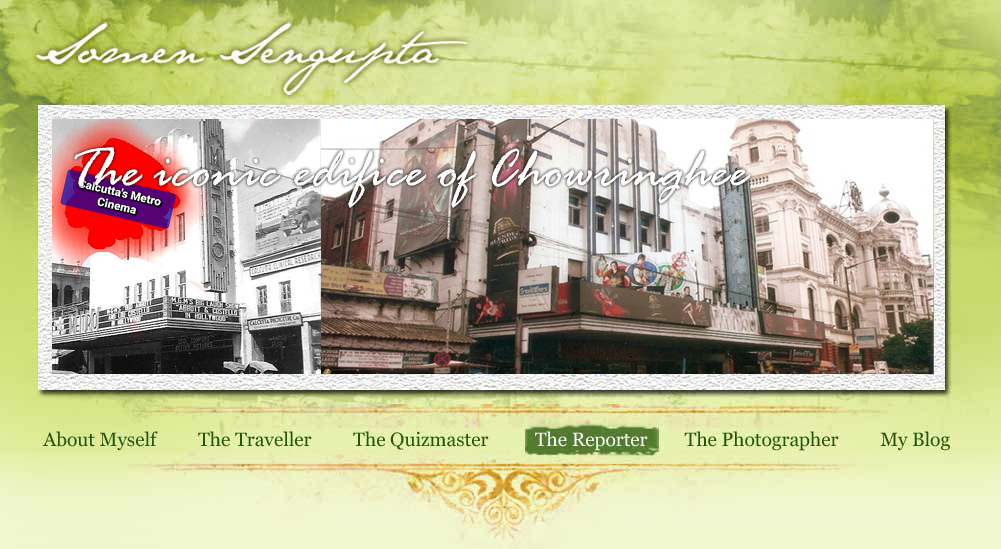
EPITOME OF COSMOPOLITAN CULTURE
The Statesman – 17th December 2021
There was a time in Calcutta when a visit to Metro Cinema was mandatory for any film enthusiast.
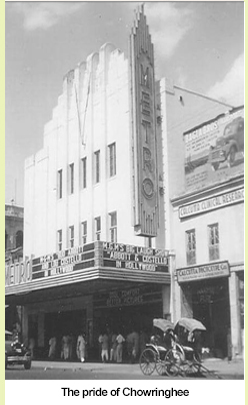 In Calcutta, Metro Cinema held the same significance for films as the College Street Coffee House for literature. From 1912 onwards, cinema was emerging as the most popular medium of entertainment. And the industry was mainly based in Calcutta and Bombay, both witnessing a plethora of movie houses showing Indian, as well as foreign films. Chowringhee Road in Calcutta, which was at one point India’s most glamorous entertainment arena, became dotted with hotels and restaurants like the Grand, Continental, Bristol and Firpo’s; luxury departmental stores like Whiteway Laidlaw, Hall & Anderson, Army & Navy Store, and elite clubs like The Bengal Club and Young Men’s Christian Association. An array of new movie halls like Elite, Globe, New Empire, Regal, Roxy, etc came up, making the place a matchless party street, unimaginable in those times, even in cities like Hong Kong and Singapore.
On 3 December 1935, this newspaper carried an advertisement that announced the opening of a new cinema hall, owned by the world-famous American movie house Metro-Goldwin-Mayer. It read, “Calcutta Metro Mad -- Not a Single Seat Left for Gala Opening”. The other hall that MGM opened in the country was in Bombay in 1938, which is still running. Designed by Thomas W Lamb, the structure of the movie hall in Calcutta was in the art-deco style. Its amenities couldn’t match any other cinema hall of the country. The venue soon attracted the city’s huge English-speaking population and those who cared for quality English movies. On 15 November 1957, the first Bengali movie -- Uttam Kumar and Suchitra Sen-starrer Chandranath -- was released there.
Thus began the journey of an elite, cosmopolitan Calcutta, which continued till the early 80s, before its pathetic degradation and final closure. From the beginning, it showed the best English movies, both old and new. A time came when a visit there became mandatory for any film enthusiast. The titans of Bengali cinema, like Kumar, Satyajit Ray, Mrinal Sen and Tapan Sinha had their own memories associated with the hall.
 Thanks to its amenities and choice of shows, the royal families of Murshidabad, Cooch Behar and Burdwan, and industrialists like the Birlas and Mukherjees used to frequent the place. A complete entertainment zone, the hall was equipped with a well-stocked bar and snacks counter, and an excellent lobby, regally furnished with a carpet and the finest curtains. It had an exceptional air-conditioning system, and elegant lighting illuminated the entire structure. The “Tobacco Box” in the front was reserved for smoking, while the area around the bar was decorated with comfortable furniture, allowing visitors to relax. Thanks to its amenities and choice of shows, the royal families of Murshidabad, Cooch Behar and Burdwan, and industrialists like the Birlas and Mukherjees used to frequent the place. A complete entertainment zone, the hall was equipped with a well-stocked bar and snacks counter, and an excellent lobby, regally furnished with a carpet and the finest curtains. It had an exceptional air-conditioning system, and elegant lighting illuminated the entire structure. The “Tobacco Box” in the front was reserved for smoking, while the area around the bar was decorated with comfortable furniture, allowing visitors to relax.
Even the signage “Metro” became so popular that Kanan Devi, top actress of the 1930s and 40s, had earrings inspired from it. Recalling its heyday, film historian Chandi Mukherjee said, “Going to the Metro for a movie was always supplemented by a visit to its bar, which was tastefully decorated with vintage photographs of Hollywood stars. The ambiance inside the cinema was magical.”  Its decline began from 1969, when capital started dwindling, along with the cosmopolitan culture. The ownership changed hands several times andfinally, rested with someone who, perhaps, had not even visited the property. Its decline began from 1969, when capital started dwindling, along with the cosmopolitan culture. The ownership changed hands several times andfinally, rested with someone who, perhaps, had not even visited the property.
With a change of viewers, the quality of movies also started changing. And sadly, from the mid-1980s, Metro, along with many other cinema halls of Central Calcutta, was gradually reduced to places showing third grade English movies. With lack of maintenance, the property started crumbling. The carpet became tattered and faded, cracks began appearing on the roof, and the toilet was filthy. Rats and spiders took over the floors and walls. The bar, which was once frequented by superstars and elites, slowly turned into a place of shady affairs. The grand staircase was marked with betel stains. A class of new-age spectators started demolishing the hall properties if something did not please them. By the end of the 1990s, it was hardly a place to go with one’s family.
Expressing her disappointment at its condition, film historian Shoma A Chatterji said, “I grew up in Bombay hearing so much about Calcutta’s Metro, which was much bigger than its Bombay cousin. Sadly, when I shifted to Calcutta in the mid-90s, Metro was not even a shadow of its past. It was nearer a ruin.”
With a few more years like that, the hall was finally shut down in 2011, and taken over by a big business house in 2016. In 2019, a shopping mall was built in the premises, with a multiplex launched in February this year. At present, it has two screens.
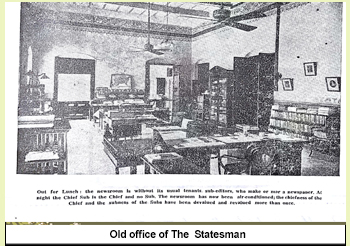
Interestingly, The Statesman and Metro Cinema have a shared history. The hall was built in 1935 on the same plot where the newspaper started its journey in 1875, until it moved to 4 Chowringhee Square on 17 December 1932, at the iconic Statesman House. From Paul Knight to Samuel Ratcliffe, many legendary editors worked at the initial office, and it was there that one Atul Sen tried to assassinate the newspaper’s then editor Alfred Watson on 5 August 1932. It is good to see that movies are back at Metro, though with a lot of compromise. Only time can tell whether it can bounce back. Until then, may the heritage be revived in its new incarnation.
Click here to view the original article
|