HARBINGER OF GREATNESS
The Statesman - 27th August 2021
On 26 August 1955, an unknown Bengali director released his debut film. Its profound significance was chronicled in these pages at the time
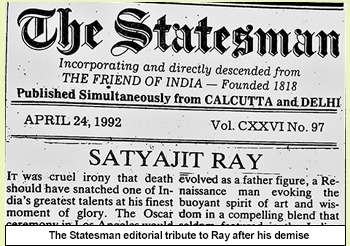 In 1955, the year his debut film PatherPanchali (Song of the Little Road) released, Satyajit Ray’s was a name to reckon with in the world of advertisement and book design.
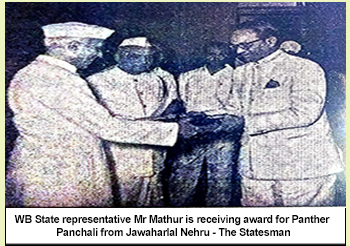
Based on Bibhutibhushan Bandyopadhyay’s novel, the film faced acute financial and technical challenges till the young filmmaker’s dream was salvaged once the Government of West Bengal came onboard as producer.
After three years of toil, PatherPanchali was ready for release on 26 August 1955. It had neither stars nor song or dance routines. Instead, it portrayed the story of a poor family from rural Bengal that experiences acute poverty, debilitating sorrow, irreparable loss and forced migration to Calcutta. Being such a contrast to the cinema of those times, many film critics doubted its success before release. A well-known Bengali magazine even refused to print still photographs from the film since they were “pensive and gloomy”.
A couple of things, however, worked in the favour of that “low-key” film.
First, its eye-catching poster that was designed by Ray himself. Indian cinema was unaccustomed to seeing such an exceptional expression of art in a film poster — two silhouetted figures of a girl and her young brother in black ink. Once they were put up at various street corners of Calcutta, people started talking about the film.
 Another significant factor was apreview published in The Statesman on the day of its release on 26 August. As an unknown 27-year-old in 1948, Ray’s article titled “What is wrong with Indian films” had been published in the pages of the newspaper. Another significant factor was apreview published in The Statesman on the day of its release on 26 August. As an unknown 27-year-old in 1948, Ray’s article titled “What is wrong with Indian films” had been published in the pages of the newspaper.
The preview started with a “burning question” that asked about the need for stars in a film based on a “realistic story of the soil written by an author of repute and read by millions”. It wondered whether “picture-goers prefer stars or unknown actors to play characters?” Hailing Ray as “a creative director” and “genius in commercial art”, the preview explained his belief thus, “realism is lost when attention is given more to the star cast than to characters in the story”.
The Statesman marked the film as a “bold venture in many respects”by saying that a “major portion of the film has been shot outdoors in a village and the players had no resources to make up” to “give a real atmosphere to the story”. The realism of PatherPanchali was further praised with the words, “these scenes have been photographed more beautifully than generally achieved from mechanically made rain”.
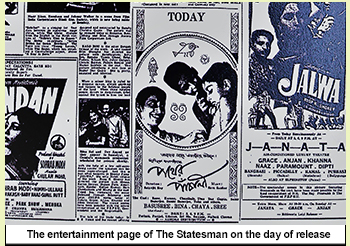
Sixty-six years ago, the entertainment page of this newspaper contained an advertisement for the film that announced its release at the cinema hall chains of Basusree, Bina, Chaya and Sree. Though the film’s and author’s names were in Bengali, all other details including the names of Ray as director, Ravi Shankar as music director and the cast members were in English. A line in Bengali above the words PatherPanchali read, “Awshamanno granther awbhaboniyochitrorup”, which can be translated as, “Unimaginable picturisation of an extraordinary novel”. A still from the film featuring Karuna Banerjee, Uma Dasgupta and Subir Banerjee was also placed on theentertainment page under the section “Indian Films”.
It is worth mentioning that the same page contained advertisements for a few more Bengali and Hindi movies like KaloBou, Kundan, Jalwa and Naqab Narayan.
Two days after release, The Statesman published a long review of the film on 28 August 1955, which offered a fitting homage to its merit.
Describing it as a “moving and emotionally compact picture”, the reviewer acknowledged “how patiently and meticulously the director had prepared himself before he put his hand to the book”. The review clearly avowed the collective success of the film. It talked about the art direction by Bansi Chandragupta, cinematography by Subrata Mitra and Ravi Shankar’s musical score. Mitra’s compositions were hailed while the sound projection was called “unsatisfactory”.
Praising Shankar’s music, the review said that it had “hardly a parallel in Indian films” because it was done with a “few simple Indian instruments and occasionally, the unaccompanied shaky treble of an old woman’s voice”. The most significant part of that review was a special mention for aged actor Chunibala Devi. Her outstanding performance was described thus, “Of the cast, the first to be named is Chunibala”.
As PatherPanchali changed the face of Indian cinema forever, its profound significance was captured by The Statesman. Discussions about the film by both film critics and common readers continued for several months in the paper.
Amid all of them, there was an unforgettable article by revered critic Amita Malik. She wrote that if one has loved PatherPanchali, then he/she has loved India as well. She went on thus, “PatherPanchali is India sometimes at its most depressing, perhaps also, you will admit, at its most sublime”.
Click here to view the original article
|