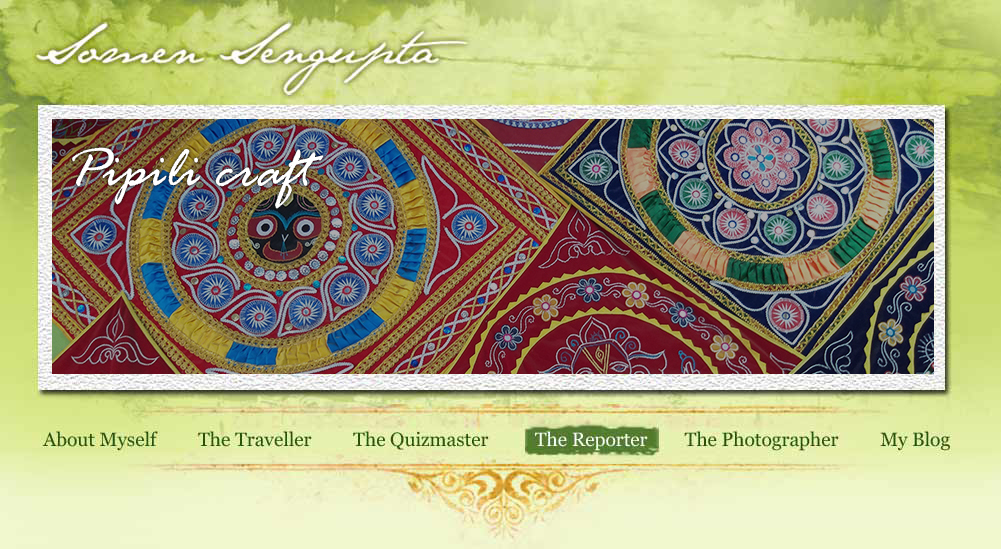
Fading Memories of Vibrancy
The Statesman – 6th August 2021
Having elevated Pipili's appliqué art to the status of Odisha's cultural identity, its originators today grope in the dark
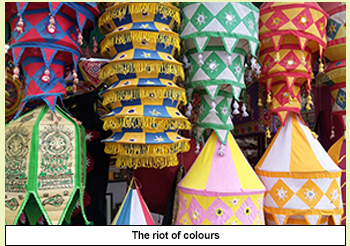 An inescapable indulgence of colors gives a call to stop at Pipili village of Orissa just 45 km off from Bhubaneswar on the way to Puri.
A long array of shops selling stitched artifacts made of cloths and glass is bound to magnet every visitor for few minutes. The shops all situated at Chandua bazaar of the village are stocked with a very special kind of appliqué art crafted on cloths. Loaded with unique stitches and thematic content these appliqué art has converted every single hut of the village into an art studio. Here almost everyone is involved in creating magic with thread and cloths. No wonder the art of Pipili now has a GI tag with it and in 2004 edition of Limca Book of Indian Records this special master crafting is credited for creating “ world’s largest thematic appliqué”.
If Bihar and Bengal have it’s heritage of Madhubani painting and terracotta clay modeling Orissa has enough reason to talk about the craft of Pipili to match a class of similar standard.
It is the market place of Pipili a tiny hamlet where pieces of clothes, glass, plastic balls and embroidery stitches come together to create a loud blast of color rendering an exceptional feast of eyes. For several centuries this unique appliqué hand craft of Orissa is donning artistic space of India’s heritage and it’s glory is now travelling across the world.
History was not very careful to record how this art emerged in Orissa.
In 12th century this special crafting skill started here as a culmination of Jagannath culture. It bloomed from 17th century onwards when every single chariot of Orissa start using this specially stitched shamiyana and umbrella to decorate the deity and chariots during Rathayatra, all kind of royal procession and other social festival.
 So as a temple art various people near Puri obtained a chance to produce colorful needle work on cloths decorated with small pieces of glass and metal. It was the time when nearly 15 karigar families were settled in Puri by local King to make Pipili styled appliqué clothes for Jagannath’s rathyatra. Till now members of only those families are allowed to stitch covers of Puri temple’s rathyatra. So as a temple art various people near Puri obtained a chance to produce colorful needle work on cloths decorated with small pieces of glass and metal. It was the time when nearly 15 karigar families were settled in Puri by local King to make Pipili styled appliqué clothes for Jagannath’s rathyatra. Till now members of only those families are allowed to stitch covers of Puri temple’s rathyatra.
With the pace of time this art was not confined within the chariot and temple.
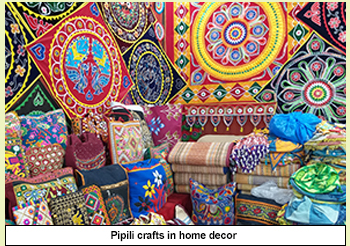
Breaking it’s barrier of being a religious décor it started influencing human life as an attractive show piece to decorate home and community area. It’s shadow started engulfing various commodities of day to day life. Today the craft of Pipili is applied in designing of handbag, garden umbrella, party decorative, pillow covers, purse, wall hanging, lamp shade, cushion cover and many more.
Pipali appliqué is now a fashion element donning ladies kurta, skirts, blouse and other dress material. Even office stationaries like files, folders, envelope and book marks are also coming up containing the artistic touch of Pipili appliqué. The colorful appliqué lamp shade of Pipili now dons airport lounge to film festival arena to Durga puja pandal.
It is the floral design with various hindu motifs that primarily dominates as the subject of Pipili work. However apart from flora and fauna various character of Hindu mythology and epics with animals and birds are also the subject of it’s craft. Peacock, elephant Ganesha and Lord Jagannath are the most common subject.
he community that is traditionally involved in this is called “doraji“ meaning tailors in Oriya. The skill of designing and embroidering are passed from generation to generation although now people from other community are also coming to master it. Surprisingly Delhi and NCR have now become a big place where local people are gradually learning the skill of needle and creating Pipali like appliqué.
So all artworks available as Pipili artwork is not actually made in Pipili anymore.
A good part of these artifacts are also the products of another heritage village of Orissa named Raghurajpur.
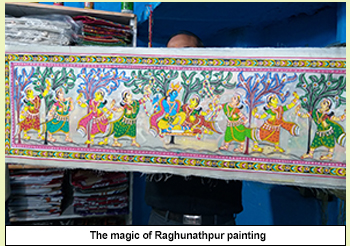
 T The mind blowing crafts of Raghurajpur a village 26 km from Pipili are not made on cloths. It is painted on tasar silk and talpatra that is palm leaf. This is mainly a style of miniature painting made on natural color though nowadays artists are using chemical colors. In this art human figure comes dominant followed by floral design and figures mainly taken from characters of Krishnaleela, Hanuman and Ramayana. The eternal love story of Radha and Krishna is an omnipresent subject of talapatra and silk. Like appliqué art work here also blast of colour and a special styled figures are distinctive all the way. T The mind blowing crafts of Raghurajpur a village 26 km from Pipili are not made on cloths. It is painted on tasar silk and talpatra that is palm leaf. This is mainly a style of miniature painting made on natural color though nowadays artists are using chemical colors. In this art human figure comes dominant followed by floral design and figures mainly taken from characters of Krishnaleela, Hanuman and Ramayana. The eternal love story of Radha and Krishna is an omnipresent subject of talapatra and silk. Like appliqué art work here also blast of colour and a special styled figures are distinctive all the way.
Earlier all raw materials were locally sourced. Now cloths come from Surat of Gujarat while thread and glass pieces come from Calcutta. Some materials are now coming from China also.
Inspite of it’s significant presence and recognition the appliqué art of Pipali is now passing through a grave crisis and it is sad that a development has caused this peril.
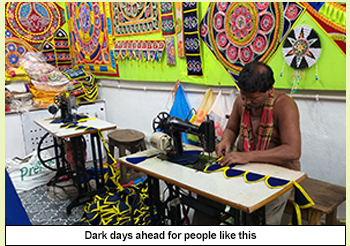
Earlier the state highway 203 at the edge of which the village Pipili stands was the only road connecting Bhubaneswar and Puri. So tourist vehicles moving towards Puri and Konark used to touch it. Now thanks to the super express highway of NH 316 all vehicles are diverted to that leaving Pipili isolated. This has caused a massive fall in visibility and frequency of customers in Pipili. The impact is so significant that within few years numbers of artifact shops have reduced to 54 from 72. A large number of remaining shops are also planning to shut down as demand is sharply falling with constant increase of cost of production. Karigars who have lost their jobs are now changed their profession to contract laborers and other odd jobs.
Ajay Kumar Mahapatra after working as hired karigar under many years had opened his small shop in 2007 with loan from Government. Till the time new express way was not operational and everyday there was traffic congestion in the village with massive footfall of tourists and pilgrims he used have a gala business. The same man today hardly finds a customer even in festive season like Dol yatra, Rathyatra, Janmashtami and Durga puja.
Do you know how much is my counter sale since morning today ? He asked with a pensive look. It is just Rs 40 ! Yes you have heard it correct .I have not earned even Rs50 in last 6 hours though I have to pay daily salary to 4 employees apart from supporting a family. With heavy rain there was thunder booming in sky on that afternoon when I started quizzing the man. Standing at his colorful shop of handcrafts I saw more cloud on his face than the gloomy sky.
 Ajay a qualified law graduate opted for this profession 12 years ago as the situation was brighter. Even a sale of RS 30000 a day was not abnormal in those days specially during winter and Rathyatra time. Now apart from the missing tourist another challenge is Delhi made Pipili appliqué flooded in many places of India. Ajay a qualified law graduate opted for this profession 12 years ago as the situation was brighter. Even a sale of RS 30000 a day was not abnormal in those days specially during winter and Rathyatra time. Now apart from the missing tourist another challenge is Delhi made Pipili appliqué flooded in many places of India.
In 1972 Pipili Cooperative Society was formed. It has 52 members whose subsistence depend on the survival of the craft. Their issue is placed to local MP Pinaki Mishra and till now no solution is offered from Government.
Raj Kishore Mahapatra is a 2nd generation trader of Pipali art. His shop founded by his father is 45 years old and has grandest stock of both Pipali and Raghurajpur artifacts. He is also equally down in spirit. Once his daily sale was Rs 50000.The same man is now looks for customer with hard effort and a monthly sale of Rs 40000 seems enough to him.
The silver line is that Utkalika the state Government runs art shop chain still sources it’s stock from Pipili and Raghurajpur. Presently more than 400 karigars who earn anything between Rs 7000 to RS 10000 a month are largely not paid as per Orissa Government minimum wage. Most of the shop pay piece wise payment. Bonus is given before Durgapuja and special allowances are given during Rajjautsav and Kumar purnima two famous local festivals of Orissa.
" We are no more dependent on tourist. Rather we look forward for Government orders and orders from temples during Rath yatra and Durgapuja." – exclaimed Raj Kishore.
Everywhere infrastructural development brings prosperity to it’s people but in case of appliqué art of Pipili which was largely dependent on tourist influx is doomed for the same. Like it’s surprising emergence from a mere temple art to a strong cultural heritage of place appliqué art of Pipili is again gropping in dark. – This time as it seems painful. The gradual reduction of revenue in this is a clear indication that the kaleidoscope can be broken at any time.
Click here to view the original article
|