| A poem that changed Hindi poetry forever... |
|
The Hitavada - 9th October 2021.
 For centuries the festival of Durga Puja is mingled with creative literature written in Bengali, Oriya,Assamese, Nepali and Hindi.
One of the ground breaking poetry in Hindi was once written as a festival piece during Durga Puja and it was written in Calcutta by one who was educated in Bengali medium school with Bengali as primary his language.
The man was legendary Hindi poet ‘Nirala’ whose original name was Surya Kanta Tripathi. Born in Bengal’s Midnapore district Suryakant had very little influence of Hindi in his growing years. Asastudent of Bengali medium school,hewas rather grown up by reading Rabindranath Tagore and Bankim Chandra Chatterjee in their originals.
Later Nirala translated many classic Bengali write ups of Tagore and Bankimchandra in Hindi.Surya Kanta was pushed by his wife tostart learning Hindi and in short span he became famous intheworld of Hindi literature.
By mid 1930s Surya Kant by then known as Nirala became a tall figure in Hindi ‘Chayavad’ movement.Inthatera he got a seat beside stalwarts of Hindi literary world like Sumitra Nandan Panth, MahadeviVerma andHarivansh Rai Bachchan.
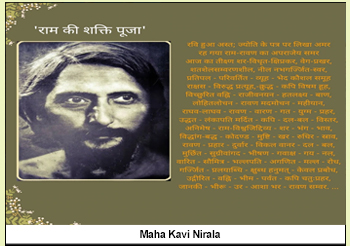
On October 23, 1936 Nirala completed along kavyanatya titled ‘RamKiShakti Puja’ in Calcutta and the same was published in an Allahabad based Hindi daily named Bharat on October 26, 1936.
Later it was included in his poetrycollection Anamika and rest whatthey say is history. Within a week of it’s publication the poem stormed Hindi readersfrom Allahabad to Patna. Though it offended few, but Nirala was not castigated by larger part of the readers and
scholars. This long poem borrows it’s theme from a part of Ramayana.
The poem at it’s initial part describes how all power of Shakti come together to giveRavana an unvanquished status before whom even Ram fails. Nirala illustrated Ravana’s image with less evil element and packed with more wisdom that best owed upon him through divine support of Shakti. Onthe contrary Ram
as per Nirala is brave, skilled but exhausted and frustrated to handle such anenemy. He in poem even cries but soon regains his self esteem to challenge his enemy. This new makeover of Ram’s character was indeed an earth shaken presentation to Hindi heartland.
 Ram that comes from Tulsidas’s Rancharit Manas or the original Sanskrit Ramayana written by Balmiki is a near God. There he isasupreme idol of a super natural entity who is above all
demerits of human character. Ram that comes from Tulsidas’s Rancharit Manas or the original Sanskrit Ramayana written by Balmiki is a near God. There he isasupreme idol of a super natural entity who is above all
demerits of human character.
Tulsidas’s execution of Ram is so super normal and divine that it was an impossible glass door to break for one in establishing a rational image of him. Nirala was brave in his style and execution and his poetry was proved as a distinctive presentation. Educated under Bengali teachers in school and having an upbringing completely in Bengali cultural atmosphere he from his childhood had been reading lot of Bengali books including Bengali Ramayana translated by Krittibas Ojha. Now Krittibas who translated Ramayana in Bengali from Sanskrit illustrated Ram as a common man with high knowledge and military
skill. At the same time Ravana in Bengali Ramayana is not an ordinary devil, but a man of wisdom who misuses his supreme power. So Bengali Ramayana of Krittibas and Hindi Ramayana of Tulsidas are very fundamentally different both in content and characters.
Dr PC Tandon noted Hindi professor of Delhi University has marked this poem as a path breaker because it was first ‘chanda mukt kavita’ in world of modern Hindi literature. Asper him the excellent blending of divine and human characters of Ramwas indeed unknown
before Hindi world and it was a master stroke by Nirala to establish a rational
approach to epic Nirala picked an episode of Ramayana’s battle written by Krittibas
and this part was neither in original Ramayana nor in one translated by Tulsidas.
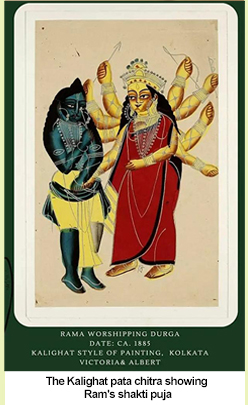
The Durga Puja of Ram known as ‘Akal Bodhan’ isacreative inclusion of Krittibas. He has shown Ram as a warrior but at the same time a human being with all domestic merits and demerits
and full of common human instincts. Here Ram is a follower of Devi Shakti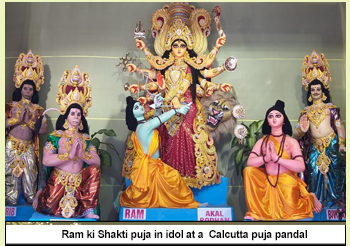 and he worships the manifestation of Shakti that is Devi Durga. In original Balmiki Ramayana, Ram is a worshipper of Sun and now here he has shown any desire to worship Devi Durga.
Ram both in Krittibas’s Ramayana and Nirala’s poem is a son of the soil and not a super normal empowered man. Though the theme and background of Nirala’s poem were uncommon to
Hindi readers still it contains all common aspect of Hindi poem like the Veerrasa, Karunrasa, Bhakti rasa, Shant rasa, Vatsalya rasa etc.
At the end, Nirala makes Ram a victor. These all were perfectly blended in this poem with the uncommon background story and it clicked.
He thus travels into the hearts of the readers as they see him sacrificing one of his eye at the feet of Devi Durga. Here Nirala’s usage of words like Rajeev Nayana is an unique application.
This expression later became a common word in Hindi language. Ram’s offering of his eye as a replacement of a lost lotus is described in this poem. It follows Durga emerges to bless Ram and bestowed all power to destroy his foes. Here Bhakti and Karun rasa are followed by Veer rasa.
In nutshell Nirala very articulately took a part of Bengal’s literary heritage
and blended that well with various rasas of Hindi literature. Bengal’s contribution to the development of modern Hindi language is enormous, but thisepisode is largely unknown.
Click here to view the original article
|