Sans Souci : A Pristine Past of Calcutta Theatre in oblivion.
The Statesman - 26th August 2022.
 As soon as the British rule in India was cemented in June of 1757, the investment of British capital through East India Company and other individual traders flooded the country. It pushed the city of Calcutta to emerge as one of the prime city of Asia truly multinational in it’s cosmopolitan culture.
From 1760 onwards Calcutta had started experiencing an unimaginable growth as a city where a new European wave was washing away almost everything that was traditional and orthodox. With new medium of education and new system of land revenue like permanent settlement Bengal was gradually becoming a potboiler of new Anglo- Indian culture and side by side it was also becoming a hub of pure European colony with club, secret society, public library, debating society, literary clubs and the rise of theatre in it’s pure European form.
Records goes that the first European theatre in Calcutta was established in 1756 named New Play House. The theatre was destroyed during Siraj-Ud-ulahha’s Calcutta attack. In 1775 a modern theatre named The Calcutta theatre was established. Such was it’s grandeur that it was described an equal to “ the most splendid European exhibition “.It was shut down in 1808.
In 1795 a Russian named Gerasim Stepanovich Lebedev founded Bengali Theatre at Beadon street ( or at Ezrra street ! ).The first play was staged on 27th November 1795. The name of the plays were “ The Disguise” and “ Love is The Best Doctor “.
In next 50 years this city saw a revolution in European theatre. One after another theatre building started coming up and each of those saw some of the finest performers playing on it’s stages with best possible set, outfits, light and sound. As Calcutta was already the richest post of Brits in Asia it by then had attracted a huge European residents and theatre in evening became their best entertainment. For Europeans of that time no Indian city was any match to Calcutta’s life style and theatre was one of the reason.
 The best theatre of Calcutta was then Chowringhee Theatre which was situated at the crossing of Chowringhee road and Theatre road. The best theatre of Calcutta was then Chowringhee Theatre which was situated at the crossing of Chowringhee road and Theatre road.
Founded in 1813 this log made building was gutted in 1839 causing much of dismay to Calcutta’s theatre going crowd. The land was soon purchased by Prince Dwarakanath Tagore at a price of Rs 30100. From this theatre only the road adjacent to it was later known as Theatre Road.
This fire accident made a person jobless and she was none other than Calcutta’s top actress Esther Leach known as “ Queen of Indian stage “ who after making her debut here on 27th July 1826 at the age of seventeen was then at the pinnacle of her career.
A jobless Ms Leach initiated to build a new theatre and she managed to convince two very influential persons of that era. One was Lord Auckland and other two were Prince Dwarakanath Tagore and mostly importantly Mr Stocqueler then the editor of The Englishman the most well read English newspaper among Anglo- American population of Calcutta.
It was decided that donation will be invited to build a new European styled theatre with all modern facilities. Lord Auckland donated Rs 1000 while another sum of Rs 16000 were collected from public. Dwarakanath Tagore also had donated huge money.
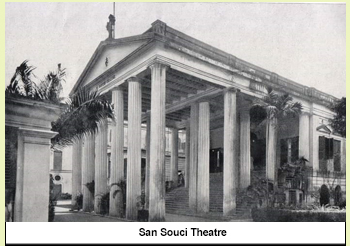 On 21st August 1839 finally she managed to open a new theatre named Sans Souci at Waterloo street with 400 seating capacity. On 21st August 1839 finally she managed to open a new theatre named Sans Souci at Waterloo street with 400 seating capacity.
Meanwhile a plot at Park street was purchased to build a complete new modern theatre named Sans Souci. The plot was addressed as 10 Park Street. The theatre building was completed in 1840 but the first play performed there was on 8th March 1841.
The new Sans Souci theatre at 10 Park street was an amazing structure designed by one J.W Collins. The external aesthetic of the building was a superb Greek Panthenon on Athenian. It had an excellent pediment on it’s front perfectly supported by six doric colomns.
A flight of stairs from the base used to meet the landing. The building was 200 ft long and 50 ft wide with high portico. The stage was 28 ft by 50ft and it’s lighting was most contemporary of the time. The hall inside was airy and with proper ventilation. It was made with best of the material and was the biggest venue of entertainment for city’s European community.
With this modern hangout place of entertainment Park Street which already had Bengal Club nearby became the party street of Calcutta a tag the street still proudly dons up. From here Ms Leach became a legend in Calcutta’s entertainment world and she became the biggest rival of another talented actress from Australia named Maria Madeline Tylor who died only at the age of 27 on 13th May 1841.
San Souci had it’s golden time from 1841 to end of 1843 when a tragic accident ended life of Ms Leach and this accident was occurred on the stage of the theatre during a performance.
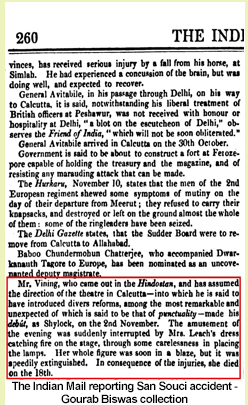 Like every evening the theatre was packed to capacity on 2nd November 1843. That day famous actor and director James Vining who was travelling to India came to San- Souci for a performance with Leach. The Indian Mail newspaper while describing the gala performance reported “……he is said to have introduced divers reforms among the most remarkable and unexpected of which is said to be that of punctuality – made his debut as Shylock on the 2nd November.” Like every evening the theatre was packed to capacity on 2nd November 1843. That day famous actor and director James Vining who was travelling to India came to San- Souci for a performance with Leach. The Indian Mail newspaper while describing the gala performance reported “……he is said to have introduced divers reforms among the most remarkable and unexpected of which is said to be that of punctuality – made his debut as Shylock on the 2nd November.”
Ms Leach who was also in the play suddenly came close to the lamps wrongly placed on the stage and soon her dress caught the fire from the flame. Though the fire was promptly extinguished but she suffered very badly. The show was called off and She was immediately taken to her residence 11 Park Street which was just next to San Souci. There after battling for more than 15 days she finally had a painful death on 18th November 1843. At that time she was the biggest star of Indian stage.She was buried at Bhowanipur Military
Cemetery as she was daughter of a soldier.Her death at San Souci was reported in all mainstream media of that time. Newspaper report says “……the amusement of the evening was suddenly interrupted by Mrs Leach’s dress catching fires on the stage , through some carelessness in placing the lamps. Her whole figure was soon in blaze but it was speedly extinguished .In consequence of the injuries, she died on 18th”.
Such a tragic accident earned San Souci a bad name.
People started thinking it unsafe and cursed theatre. The theatre was leased to a French company who were also not serious to run it in regular basis. They last performed there on 24th April 1844.
After that regular performance was ceased and the stage was then onwards used to take by small European groups to perform off and on. The theatre was locked in most of the time of the month.
In that phase a revolutionary thing took place on it’s stage in 1848 when it was hired by a small group who staged William Shakespeare Othello and for the first time in the history of European theatre in India an Indian named Baishnav Charan Adya played the title role of the play. It had two shows performed on 17th Augusut and 12th September 1848. Baishnav Charan playing a role of a Shakespeare character in an English play created a sensation in both Indian and European society of that time. Overnight he was known as “ Hindu Othello”.
The armature actor later on played a significant role in establishing of Calcutta Training School in 1859.His name is sadly banished into oblivion though he is part of Bengal’s cultural insurgence.
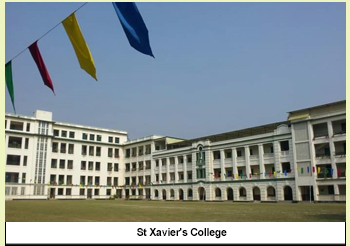
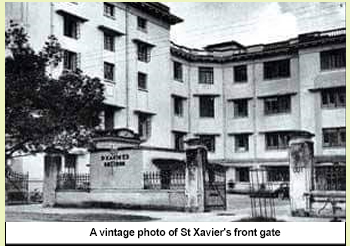
San Souci has no relics left today to see but it has it’s existence in one of the prime educational institute of the city St Xavier’s college presently housed at 30 Park Street.
In September 1849 Father Carew purchased the theatre at caprice of Rs 27500 and moved his St John’s College there. The college was closed in 1855 and on 16th January 1860 a group of Belgian Jesuits took over both 11 and 10 Park Street to establish St Xavier’s College. . Later on these two plots got a new number 30 Park Street as address.
In many counts San Souci has a paramount importance in Calcutta’s cultural heritage. It is sad that not much records are available about the theatre and there is hardly one or two photographs are now available. The only evidence of the institute is old advertisement, reports in newspapers and few memories written by some eyewitnesses.
Click here to view the original article
|