Savarkar’s 1944 Constitution draft: Was it more secular than Ambedkar’s?
The Statesman dated 9th March, 2025 & 17th March, 2025
The constitution that an independent India adopted 75 years ago under the guidance of Dr BR Ambedkar is considered one of the most celebrated works of modern times.
The Indian Constitution gave India an unmatched level of dignity where a nation’s commitment to its subject is explored and explained most vividly under a democratic secular social framework. Having said that, this can also be pointed out with no hesitation that the framing of India’s constitution was also in the line of a political party’s (read Indian National Congress) pre-set agenda.
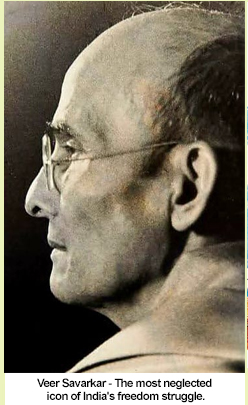
Interestingly, in colonised India, the idea of framing a constitution of free India was not only in the mind of Congress leaders who were almost sure that once the British era ended, the power would also only come to them, rather it was nursed by some of the smaller parties as well- Hindu Mahasabha (HMS), the radical Hindu organisation and a party with huge political aspirations from 1937 under Vinayak D Savarkar, the legendary revolutionary whose trial in the hands of the British once rocked the judicial system of Europe and India.
After serving his imprisonment in various forms for 27 long years, Savarkar finally had an unconditional release from the British in 1937 and soon joined HMS as its president. Savarkar in 1937 was a heartbroken man. He felt it was better than anyone else that the glorious sacrifice and suffering of unimaginable physical and mental torture executed on him had a very mild effect on the minds of mass who were almost intoxicated by Gandhi’s politics of non-violence very smartly blended with a pinch of communal salt a recipe Gandhi mastered better than anyone else. This frustration of missing the political limelight tempted Savarkar to make HMS an overly aggressive, candid and anti-Gandhi party with its clear agenda to protect Hindu interest. At the same time, he felt it best that unless HMS became a mainstream political party like the Communist Party of India, Congress Socialist Party, Muslim League, etc, it would never emerge as a true alternative to Congress to Hindu citizens of India. In 1937, Savarkar, who was then the intellectual fountainhead of Hindu nationalism, made it clear that Hindu Mahasabha is not a Hindu Dharma Sabha but a Hindu Rashtra Sabha. This cemented his political idea of making every Hindu a political Hindu and making India a Hindu Rashtra, the home of Hindu jati and living on the basis of Hindu Sanskriti. Savarkar’s book “Elements of Hindutva” defined a very complex definition of Hindu nation and Hindu culture.
With all these, Savarkar, whose party contested in the 1937 election and had its considerable number of seats, was adamant to challenge Gandhi’s Congress in every single aspect. How independent India would look as far as its citizens’ rights are concerned was important for Savarkar to push his party in the race with Congress and the Muslim League, and an alternative constitution from HMS was more than essential an instrument before Congress.
Savarkar came to Calcutta in December 1939 to attend the All India Hindu Mahasabha conference, and in his long presidential address delivered on 29 December 1939 from the stage erected at Deshbandhu Park of north Calcutta, he made the world astonished when he announced drafting of a constitution of free India.
In that meeting in Calcutta, Savarkar neither could form a team to draft a constitution of free India nor was he able to show the work that was needed for such projects. However, he was strong in his expression to give a possible outline of a future India, a country he in his entire speech referred to as “Independent Hindusthan”.
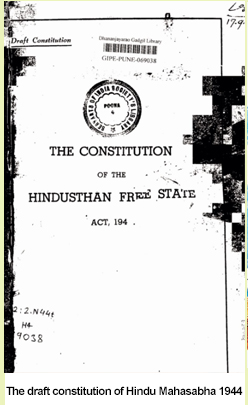 One who reads the Calcutta Presidential speech of Savarkar delivered in Calcutta will be surprised at how clear and candid he was in his conceptualisation to see India once she was free from the shackles of slavery and once she found her place in a post-war world. One who reads the Calcutta Presidential speech of Savarkar delivered in Calcutta will be surprised at how clear and candid he was in his conceptualisation to see India once she was free from the shackles of slavery and once she found her place in a post-war world.
No one expected that Savarkar would give a hint of introducing a draft of the constitution once India was free. Political observers expected that his Calcutta speech would mainly focus on the Hindu-Muslim issue, Subhash Chandra Bose’s exit from Congress and his new political moves, communal tensions across India, Muslim League’s atrocities and Gandhi’s Muslim appeasement policies causing harm to Hindu interest, etc. Savarkar left the delegation stunt when in the middle of his speech he moved to the context of the national constitution of Hindusthan which as per him was aimed at the broad principle that all citizens should have equal rights and obligations irrespective of caste or creed, race or religion provided they avow and owe as exclusive and devoted allegiance to the Hindusthan state. Savarkar added “…The fundamental right of liberty of speech, liberty of conscience of worship, of association, etc., will be enjoyed by all citizens alike. Whatever restrictions will be imposed on them in the interest of the public peace and order of national emergency will not be based on any religious or racial consideration alone but on common national interest”.
This was just unexpected from an organisation like Hindu Mahasabha, which had made it clear that protecting Hindu interests was its fundamental agenda.
Dr Arghya Sengupta in his book “Colonial Constitution” has written a clear contradiction of Savarkar’s Calcutta speech and the basic purpose of his book “Essentials of Hindutva”. Sengupta writes “…..This was a deviation from the theory of Hindutva, where even despite such allegiance being declared, a Muslim or Christian could not claim equal citizenship since their holy land factually remained elsewhere.”
However, Sengupta has given a clear explanation of such a surprising twist in Savarkar’s speech. He writes “This deviation was not unintentional – the entire edifice of Savarkar’s constitutional vision was the political acceptability of the Hindu Mahasabha as a mainstream political party. The radical nature of Hindutva ideology would now have to be toned down in an attempt to take on the Congress as the leading force in nationalist politics.”
Though the entire Deshbandhu park roared with non-stop applauses of the speech delivered by the president, a doubt was born there itself among many of the top leaders of HMS about the final shape of this constitutional draft.
Savarkar waited a few more years and finally in 1944 his last year as president of HMS he formed a team of 4 legal experts to draft a constitution of independent Hindusthan.
The four-member team comprised LB Bhupatkar, the man who would later defend Savarkar in the Gandhi Assassination case in 1948, DV Gokhle, KV Kelkar and MR Dhamdhere. The committee first met on 31 May 1944 and after consulting the constitutions of almost all countries and accumulating various judicial opinions from all the top consultants of India, shaped up a nearly 100-page tightly consolidated document named “The Constitution of the Hindusthan Free State”. The draft was submitted on 15 July 1944, when the pace of World War II was grossly changed and the defeat of Axis power was almost palpable. It had a forward written by NC Kelkar.
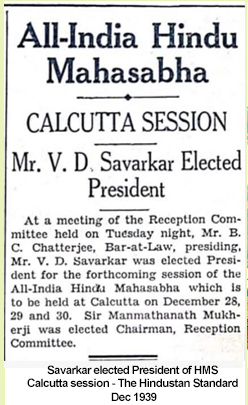 Vikram Sampath in his book “Savarkar – A Contested Legacy (1924 – 1966)” has opined that this draft constitution has taken “issues such as the minorities, Indian states and India’s future relations with Britain were all considered with an open mind”. Vikram Sampath in his book “Savarkar – A Contested Legacy (1924 – 1966)” has opined that this draft constitution has taken “issues such as the minorities, Indian states and India’s future relations with Britain were all considered with an open mind”.
The drafting committee made it clear at the beginning that the future name of the independent country would be Hindusthan and not India. It stated that “….Hindusthan being a free state and not a servient member or even a partner of any other state or Commonwealth.”
The draft had a preamble with different broad chapters covering all vital aspects that a modern state needs in its constitution to rule a civilised mass of subjects. Though it did not mention any secular state, it was clearly mentioned that the independent state of Hindusthan would not have any official religion, rather while defining the term “citizen” it did not make any differentiation based on religion, caste, creed and gender. So equality and parity among every citizen were ensured.
It supports the federal system of democracy in the format of a republic where voting rights were given at the age of 21 and the “one man one vote” policy was talked about. It discounted the cult of the separate electorate. This HMS constitution draft talked about the legislator that would be bicameral, both at the centre and the state.
Provision of admission into the army, navy and air force was made without any distinction of martial and non-martial race.
It explained 16 fundamental rights of citizens, where equality between men and women and their equal claim before the law and all civic rights were ensured.
It means that there will not be any discrimination in law, civil or penal, substantive and procedural.
Right of education and right of admission into any educational institution was also ensured without considering caste, creed and colour. Thus it clearly discounted any kind of reservation on any ground. The right of every citizen on every single national resource like roads, bridges, wells and all other public utility infra was ensured. It talked about the minimum wages of the labourers, the right to health, protection of motherhood, child welfare, economic consequences of aged people and protection of agricultural tenants were also included. However, surprisingly, it authorised the right to keep arms in accordance with the law.
One of the fundamental rights that it talked about was the right to move to the Supreme Court with a petition for the ultimate justice.
The draft made it clear that no citizen who is attending any school that receives Government aid will be compelled to attend any religious instruction. It also said that no public money and property shall ever be used or donated directly or indirectly to support any sect or religion.
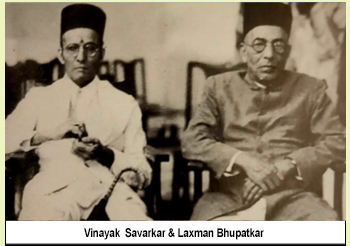 In 1939, at Calcutta itself, Savarkar in his presidential address assured the non-Hindu population of the country not to be apprehensive over HMS as far as their fundamental rights are concerned. Dr Arghya Sengupta in this context has written in his book that “………their rights regarding their religion, culture, and language would be expressly guaranteed in the constitution. Minorities could also set up special schools for their children with government support, provided the majority could do the same with proportionate state support.” In 1939, at Calcutta itself, Savarkar in his presidential address assured the non-Hindu population of the country not to be apprehensive over HMS as far as their fundamental rights are concerned. Dr Arghya Sengupta in this context has written in his book that “………their rights regarding their religion, culture, and language would be expressly guaranteed in the constitution. Minorities could also set up special schools for their children with government support, provided the majority could do the same with proportionate state support.”
Having said that, Dr Sengupta mentioned that Savarkar made it clear that minorities should maintain their religious identity “but everyone was a citizen of Hindusthan”.
Drafting a constitution like this under the tallest poster boy of the Hindutva school of politics, HMS made its political plan clear. It was their first serious attempt to blend with the mainstream politics of India under the shadow of World War II. Savarkar was more than sure in 1944 that the mighty British Empire would collapse after the war and India would get the golden chance to break her shackles.
Surprisingly, Savarkar could not make the impact of this constitution as big as it was expected. His time in HMS was in twilight. Soon, Dr Shyama Prasad Mukherjee would replace him and within 7-8 years, he, with indirect support of Guru Golwalkar of RSS, would form a new political party, Bharatiya Jana Sangh. In 1951-1952 the cult of Nehru was so strong in Indian politics that Savarkar and Mukherjee both failed to change the tide.
On 26 January 1950, when our grand constitution was finally implemented, no one even bothered to mention Savarkar’s draft and by that time Savarkar’s glorious legacy had started getting suppressed by a well-designed government machinery.
Click here to view the original article
|