Cinematic renaissance:
Calcuttas 1952 film festival that ignited icons
The Statesman dated 3rd December 2023.
In 1947, India’s attainment of freedom was marred by unprecedented fratricidal riots, the displacement of more than 7 million people, large-scale destruction of properties, and many more horrific nightmares. In that precarious situation, the country saw the assassination of Gandhi, an attack by Pakistan, a perplexing political gambit in the decolonisation of small French and Portuguese enclaves, and the inclusion of princely states in the Indian federal system.
Though the Jawaharlal Nehru government took the policy of the socialist model of welfare state, where the basic needs of people are to be given maximum priority by the government, it did not ignore the channels that help to develop human resources. Nehru’s initiative of hosting the first Asian Games in Delhi in 1951 was soon followed by
his initiative to host an international film festival travelling all four metro cities of India to give the urban cinegoers a real taste of international cinema from all leading cinema-making nations.
The task was given to Mohan Vavnani, a major producer of documentaries in the Film Division, by Nehru while they met in Kashmir in 1951. Nehru took it personally to host the event and asked the Ministry of Information and Broadcasting to render all support. A budget of Rs 1.5 lakh was sanctioned soon. It was planned that a mobile film festival would be organised in December 1951. It would show a plethora of feature and documentary
films to the cine-goers of Bombay,
Delhi, Calcutta, and Madras for two
weeks. The festival would kick off in
Bombay and conclude in Calcutta,
touching Delhi and Madras in
between.
The now-defunct film newspaper
Screen, published by The Indian
Express, first unfolded the news in a
big way in its issue dated 21 September
1951. Its headline read, “Twenty Five
Theatres for Festival Films - World’s
Best Pictures to Be Shown”. Screen
avowed in its report that top global
film celebrities like Charlie Chaplin,
Walt Disney, Ingrid Bergman, Robert
Rossellini, Vivian Leigh, Sir Laurence
Olivia, etc. would grace the occasion.
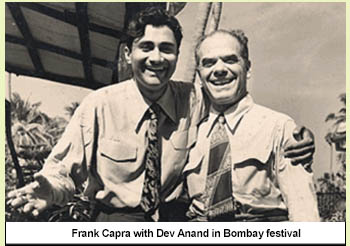
However, most of the luminaries mentioned in the report did not actually turn up. Frank Capra came and visited Calcutta during the festival. Both Italy and Russia sent a big group of celebrities. Russian director Pudovkin spent a long time with Indian cinema titans and visited many cities. Finally, the festival was inaugurated in Bombay in 1952. Azad Maidan of Bombay was the main venue, along
with several key theatres in the city.
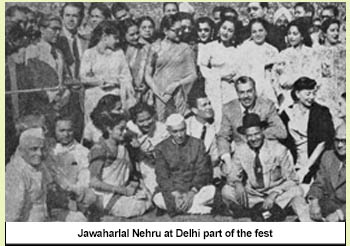
Jawaharlal Nehru could not be present
at the opening ceremony in Bombay,
but he was enthusiastically there when
the festival arrived in Delhi in midFebruary 1954.
At its last leg, the festival finally
arrived in Calcutta on 28 February
1952, after travelling to Bombay, Delhi
and Madras.
It was the gala closing ceremony
to India’s first international festival,
and Calcutta, the city that by that time
housed one of the best active film societies in India, founded in 1947 by Chinananda Dasgupta, Satyajit Ray,
Harisadhan Dasgupta and RP Gupta,
played a perfect host. Calcutta, though
badly ravaged by that time thanks to
riots, famine, partition, and the flight
of capital, was a city of extraordinary
intellectuality for American and British
films. It had a ready audience hungry
to feed more for the best of world cinema.
The festival was inaugurated on
28th February 1952 by Dr Harindranath Mukherjee, Governor of
Bengal. The Deputy High Commis
sioner of Pakistan, Dr Abdul Hamid
Chowdhury, and the King and Queen
of Nepal’s royal family were invited as
special guests. A pool of foreign diplomats, delegations, and Bengali film
actors were present at the function.
The festival arrived in Calcutta
with a pack of more than 100 movies.
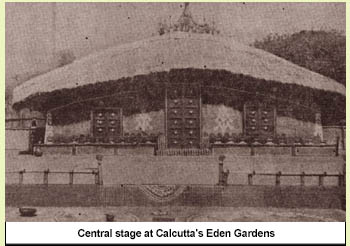
The central venue selected was
Eden Gardens, where a makeshift exhibition ground was erected with a touch
of rural Bengal. The arena was decorated with Bengal’s alpana and other
traditional motifs like double-sloping
thatched roof mud huts, wood crafts,
banana trees, hand-painted potteries,
terracotta panels, and floral designs
made of soft sola. An exhibition zone
and a central stage were done, and
every day several cultural programmes
were organised.
Like Bombay’s Azad Maidan, tents
were pitched for cinema shows, while
many modern theatres like Minerva,
Elite, Lighthouse, Purno, Basusree,
Prachi, Chitra, Bina, and Sree were also
made venues for the festival. Each theatre was allocated 5 to 7 shows per day
to run 50 feature films and 90 documentary films from 23 countries, like
Russia, Hungary, Japan, Argentina,
Egypt, America, Indonesia, Canada,
Norway, Great Britain, Italy, France,
Australia, Rumania, and even East Germany. From India, four films, one each
in Hindi, Marathi, Bengali, and Telugu,
were on the list. Raj Kapoor’s Awara in
Hindi, V. Shanta Ram’s Amar Bhoopali
in Marathi, and Agradoot’s Babla in
Bengali were the top picks on the list.
The ticket price for the public was fixed
between Re 1 and Rs 10.
In a nutshell, the festival turned
out to be a treasure box for cinegoers
of that time who, before this, only had
the scope to watch American and
British films commercially released in
Calcutta. Their exposure to cinema in
other countries other than America
and Britain literally started with this
festival.
Some of the epoch-making cinema of the history of the world, like
Open City by Roberto Rossellini, Bicycle
Thieves and Miracle of Milan by Vittorio De Sica (Italy), The River, which was
shot in Bengal, The Magic Box (Britain),
The Fall of Berlin (Russia), The Man in
the White Suit (Britain), The White
Haired Girl (China), No Highway in the
Sky (USA), Yukiwariso ( Japan), The
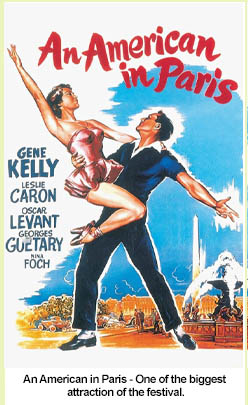
Greatest Show on the Earth and An
American in Paris (USA), and Mrs Deri
(Hungary) were shown in the festival.
No wonder Uttam Kumar, then a
struggling Bengali actor, watched
many of these movies to learn the fundamentals of acting, and he was so
influenced by Italian actor Marcelo
that he later acknowledged that his
style of acting was indeed influenced
by him. Uttam Kumar participated in
the opening ceremony of the festival
held on 28 February 1952 at Eden Gardens as an invitee. An old archival
photo shows him in the group—not
very prominently, though.
For the members of the Calcutta
Film Society, especially Satyajit Ray,
Bangshi Chandra Gupta, and Chidananda Dasgupta, it was the opening
of a floodgate of world cinema, from
which all of them picked various parts
of learning and later blended that wisdom into their own work.
After this festival, Raj Kapoor got
an invitation to participate in several
film festivals in Russia, and he and
Nargis became household names
there.
The saddest part of the festival
was that one of the best movies made
in Italy, titled Path of Hope, was damaged while being sent from Italy to
India by air. The film could not be
shown.
While city cinema halls were
showing regular movie shows in
packed houses from 29 February to 14
March the central stage of the festival
at Eden Gardens hosted a plethora of
cultural events every evening. From
Shambhu Mitra’s play to
Rabindranath Tagore’s musical opera
Shyama, and from pantomime by
Satish Ghosh to classical music
evening by Jyan Prakash Ghosh, the
festival arena went agog every evening.
A magazine stall was put up to sell
film-related magazines, periodicals,
and books published across the world.
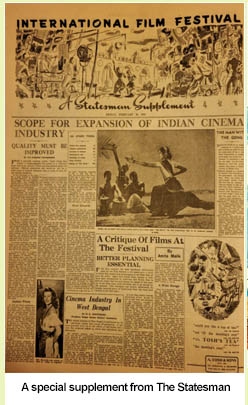
As a sentinel of the time, The
Statesman did an excellent job on this
event. While other English and Bengali
dailies in Calcutta covered the event
with considerable importance, The
Statesman on 29 February 1952 morning came up with a special 8-page
broadsheet International Film Festival
supplement, which was distributed
free with the main paper.
It was a rich collection of essays
and photographs, covering both Indian
and foreign films. Its industrial correspondent wrote a detailed article on
the scope for expansion of the Indian
cinema industry, while MD Chatterjee,
then president of the Bengal Motion
Pictures Association, contributed an
article on the cinema industry in West
Bengal. Mr Chatterjee pointed out that
a lack of capital invested in Bengali cinema is
creating a situation of under-utilisation of cinema infrastructure in the
state. The supplement contains an article by Amita Malik, the best-known
media critic in India for nearly 50
years. Amita, while explaining her bitter experience of the festival’s Bombay
episode, expected a better planned festival in Calcutta where a spectator does
not need to travel miles between two
shows in one day. No wonder her article was titled "Better Planning Essen-
tial."
The supplement also contained
articles on the British Film Industry,
Taxation on Films, Recording of
Sound,Cinema Architecture, Film Division,Distributor’s Role, etc. It is still a
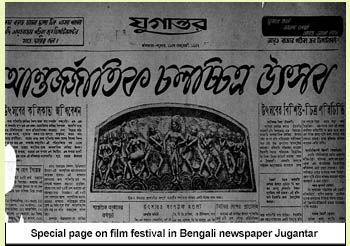
collector’s issue. Bengali newspaper
Jugantar and English newspaper Amrita Bazar Patrika also came up with
special pages on Calcutta’s first film
festival, but the supplement of The
Statesman was class apart.
Click here to view the original article
|