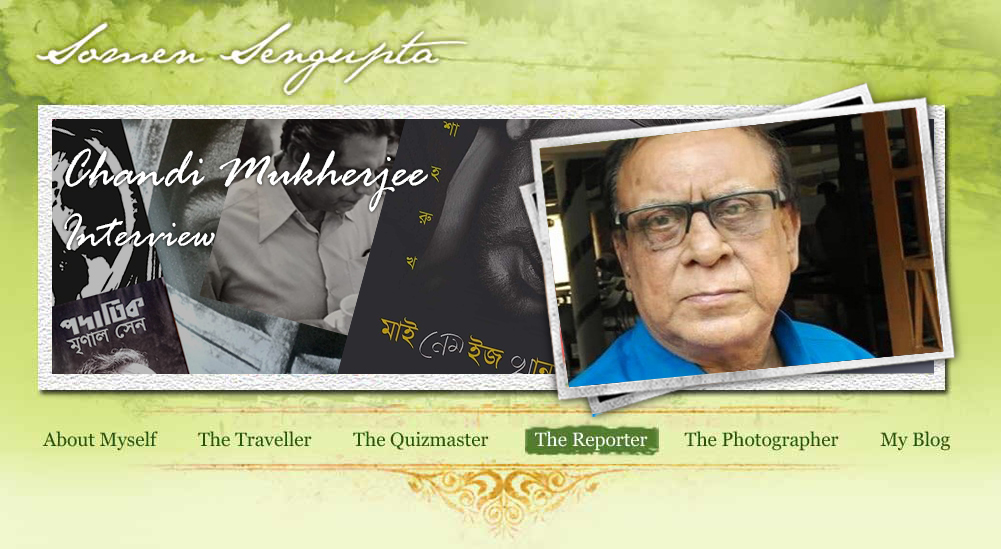
" No formula for success of a film "
Interview with Chandi Mukherjee.
The Statesman 14th October 2022.
Chandi Mukherjee is the doyen of Bengali film journalism and film studies. Having a career in writing on films for more than four decade in a leading Bengali newspaper Mukherjee is also a film historians with more than 40 books under his credit. He edits several books and periodicals on films and also contributes articles in leading newspapers .He is the present President of Bengal Film Journalist Association and also member of the jury in National Film Award Committee and Censor Board.
Here is his intimate interview with Somen Sengupta
Q - Is your engrossment with the world of cinema accidental or it has a history of systematic formation?
A – It is a destiny I must say.
I was born and bread in central Calcutta very near to Elite cinema in early 1950s. Calcutta was still a vibrant cosmopolitan and my zone was dotted with cinema halls showing English movies and block buster Hindi movies as well. Though watching cinema in theatre was not allowed for us frequently but I had a visual delight of big hoardings and posters in central Calcutta and that created an interest in me to explore the world.
In my teen we shifted to Shyambazar area which was then buzzing with plethora of cinema and theatre halls. My world of watching cinema actually started from Talkie Show House, Minar, Mitra, Darpana, Roopbani and many other show houses of that locality. I remember I was in my half pant when I watched Satyajit Ray’s Abhijaan in Sree cinema hall by bunking my class.
Q – Were you only in that kind of movies from your teens ?
A – Absolutetly not – Rather I used to watch all films specially Hindi movies starring Dev Anand and Raj Kapoor. Needless to say Uttam Kumar then the titan of Bengali movie was my top hero. I was indulged in watching movies without making any discrimination and it slowly invaded in my thought process when I was admitted in Scottish Church college in late 1960s.
Q - So unlike others you were never in dividing film into art and commercial ?
A – I hate to do so . There is only one classification of cinema that is good and bad. Ray shown us even a very good cinema can become a huge commercial hit.
Q – But how the doors of world cinema opened before you ?
A – In early 1970s I became a member of Calcutta Film Club an organisation then used to exist at Bharati Parishad Library near RG Kar Medical college. They initially refused me a membership for my too young age but seeing my profound interest in cinema I was finally taken as a member. There I got to read magazines like Sight & Sound, Screen, Ultorath , Jalsa etc and the skill of writing on films finally started attracting me.
Meanwhile I got to meet Father Gaston Roberge a Jesuit priest of Xavier’s college who was leading a film study club named Chitrabani near Wellington square and we nearly 10 young boys and girls started following him. Apart from me young Ruchir Joshi, Sunetra Ghatak, Sashi Anand , Sekhar Das and many more extra ordinary brilliant people joined him. There we not only got to see some of the finest movies of the world in 16 mm projection machine but also started reading magazines like Film Bulletin , Film Comments, Chitrabhash, Movie Montage etc.
It was here I derived an academic diploma on Film. However I never wanted to become a film director. My motto was always to become a writer and reviewer on cinema – I was very focused from the beginning.
Q – Was your outlook on popular cinema changing in that time ?
A – Yes …I was having a feel that those superhit Uttam Kumar movies for which I was once crazy are no more appealing me. Even I was slowly understanding the difference of real India and India that popular Hindi cinema shows us. It was an awakening.
Q – Was that experience enough to become a film critic ?
A – No…Soon I was sent to Pune Film Institute in 1974 for another course and there I really understood how India of my generation think about cinema. My days in Pune were unforgettable. There I not only found a galaxy of bright teachers and friends but also a library that remains open all the night for it’s readers. Pune experience enhanced my wisdom in many folds.
Q – But still you were not writing or researching on cinema – you became a film correspondent ?
A- An offer landed on my lap in 1981 when a new Bengali daily Aajkal commenced from Calcutta .
It was a new age newspaper and it was first Bengali newspaper to introduce a regular Page3 type of content. I got the job and settled in life but it took me few years to establish myself in the film journalist circle. In 1986 when Mithun Chakraborty organised Hope86 extravaganza in Calcutta I did a daily updation of the event from the most intimate side. My personal proximity to Mithun gave me huge access to every single titbits of the event and my paper almost everyday printed that in front page.
This promoted me to become Ajkal’s cinema page head and took to me to Bombay where I got several assignments with BR Chopra to Rekha to Amitabh to Ompuri and everyone.
Q- Can you single out any unforgettable incident of that phase ?
A – There are many but I must say that I was the first Indian cine journalist who cracked the news from BR Chopra’s lips that he is going to produce a mega serial on Mahabharat for television. The news created a wave across India when Ramayana was already beaming in television.
Q – How will you evaluate Hindi cinema of 1980s to today’s Hindi cinema ?
A – See India after 1991 economic liberalisation has transformed into a very different country. You can not expect to see it anymore that a boy coming from village to a big city and falling in love with a rich girl kind of story because that is no-more an aspiration of a common Indian. Today as the aspiration of society is very different the subject and acting style of Hindi cinema is also very different. Till mid 1990s a multistarer movie with six songs and 3 dance was an established formula now success does not follow a formula – It follows right application of thoughts with the moviegoers.
Q- Is that same for Banegali cinema as well ?
A – Bengali cinema after the death of Uttam Kumar in 1980 went into a bad patch and then from 1985 with the release of a movie named Shatru saw it’s commercial success but it killed the cinema as a visual delights. Rather it became a medium of sound where dialog started dominating the subject. However things changed from mid 1995 with advent of Rituparno Ghosh and Koushik Ganguly etc.
Q – Out of Satyajit Ray, Mrinal Sen and Ritwik Ghatak how will you place them in the history of Indian cinema ?
A – They all are great in their own merit and except Ritwik both Ray and Sen changed themselves with the time . My own interaction with both of them for many years made me realised that they tried their best with changing time. However at the last stage both were at their saturation point of excellence . This is natural and I do not blame them for this. Ray for his physical illness was forced to do indoor centric movies from 1988 and that faded his magic. Mrinalda also was nomore at his best from late 1980s.
Q- Do you rate Ritwik as one of the best filmmaker to capture partition of Bengal ?
A – That is a myth. Ritwik’s movies known as partition movies do not actually reflect the political side of partition. He very tactfully avoided that disturbing subject thanks to his political affiliation to CPI. His flims are all on personal pain and pangs of people who are victim of partition. I do not accept that as partition film.
Q – You seriously started film research little later and mostly concentrated on world film – correct ?
A – I started authoring books from 2012 and till now have authored 43 books all in Bengali. My first book was on Uttam Kumar whom I met and interviewed in 1978. It was a huge experience.
However I later authored book on Charlie Chaplin, Marilyn Monroe, Jean Luc Godard, Alfred Hitchcock, Greta Garbo, Ingmar Berman and Brigitte Bardot and many more. These all icons were very popular among Bengali cinegoers but before mine there was no serious book on them in Bengali.
I also worked on Tagore and Cinema, Hiralal Sen the real pioneer of Indian cinema, Ritwik Ghatak and even on Ray, Shahrukh Khan, Amitabha Bacchan and Mrinal Sen.
Q – What is the real challenge in film research in India ?
A – Very pathetic archival material .
Neither the film nor any important documents are properly preserved and with time many matchless documents and photographs are now lost for ever. Can you imagine that we do not have any good photograph of Hiralal Sen and not even a single still of his so many works ? Our film libraries are unorganised and most of the books written on cinema is very poorly researched. I have visited big Hollywood studios like Paramount, Sony, Warner Brothers etc in US with special approval from Hollywood Cine Guild and was floored to see the way they have preserved every single document of their film in their archive. We can not even think to do that in India. However nowadays National Film Archive is doing some serious jobs but in Bengal things are still at precarious stage.
Q – You have chaired many top positions in film organisations. Which one you really enjoyed out of those ?
A – I was a member of the jury for President’s National Award for three years and was also a member of Censor board for a long time. Both the positions gave me ample scope to learn Indian cinema across provinces and I am greatful as a student of cinema for that opportunity. Thanks to these positions I got to know how fast the cinema making is changing in India.
I am also the president of Bengal Film Journalist Association but I feel BFJA has not performed it’s proper role in promoting right kind of Bengali cinema. This is no doubt a regret.
Q – What is the finest memories that you like to share from your colourful career as film historian and journalist ?
A – Satyajit Ray once said in an interview that Nobel prize must be instituted in cinema. His this comment made waves across the world and I was there in this interview. I once spent more than 48 hours with Ray and made full coverage on him for my newspaper. It was 23rd to 24th April 1992 when he died. It means I was with his mortal remains only. This is an achievement as well as a deep pain for me .
Click here to view the original article |